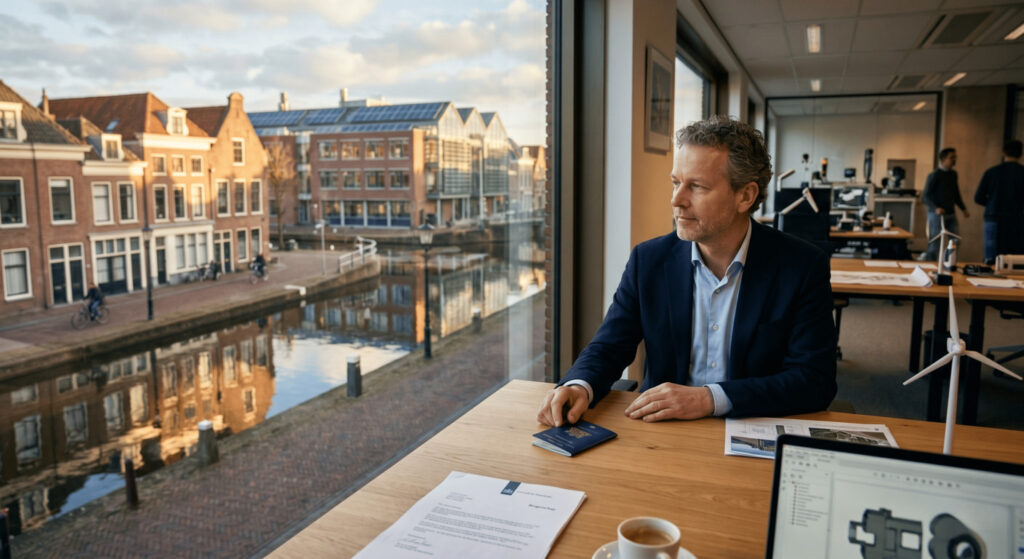
Today I am sitting in an office overlooking the intricate network of canals in Delft, watching the sun catch the glass of the research labs across the water. On my desk lies a letter from the Dutch Ministry, officially confirming my citizenship. It is a document that recognises my exceptional contributions to the country’s engineering landscape, which is a formal way of saying that my ideas and my work have earned me a home here.
To the colleagues who pass my door, I am simply the lead systems engineer who solves the problems no one else can. They see the success, the patents, and the quiet discipline I bring to every project. They see a man who has achieved great things in a foreign land.
But as I look at that passport, I know that the most important thing I ever engineered was my own escape.
It was not always like this. A decade ago, I was not designing sustainable infrastructure. I was a ghost in my own life, trapped in the crushing cycle of drug addiction. Back then, my office was a park bench or a locked room, and my only goal was to find a way to stop feeling the weight of the world. I had burned every bridge and convinced myself that my story was already over.
The shift began when I entered a rehab centre. At first, I felt like a machine that was too far gone to be repaired. But the people there saw me differently. They helped me realise that life is just a series of systems. I had spent years breaking mine down, but I still had the capacity to rebuild. That facility provided the blueprint I needed to start over. They gave me the tools to stabilise my foundation and taught me that recovery was the hardest project I would ever manage.
It required a level of technical precision by monitoring my triggers, re-wiring my habits, and reconstructing my integrity from the ground up. With the support of the centre, I went back to university not just to get a degree, but to prove that a shattered foundation can be reinforced to hold more weight than the original ever could.
I moved to the Netherlands with a heavy past and a fierce hunger to be useful. I used the focus I once wasted on my addiction to fuel my innovations in energy systems. My knowledge did not just give me a career. It gave me a new identity.
Today, I am not just an engineer working in a prestigious Dutch firm. I am a man who survived the wreckage of his own making, and I know that the strength of a structure is not just in the materials you use, but in the lessons you learn while you are putting it back together.